Metal Gate Repair in Mount Pleasant SC: the Salt Air Checklist
Salt does not attack a gate evenly. It goes after joints, fasteners and wiring terminals first, and it leaves the painted faces looking respectable for years while the parts nobody inspects fail. That is how a coastal gate can photograph beautifully in March and refuse to move on a Tuesday morning in July.
Most published advice about metal gates was written for dry inland ground, where rust is a slow surface event and the only electrical risk is a thunderstorm. A few miles from the marsh the rules change. Chloride lands on every surface with each onshore breeze, dries, and sits there until humidity puts it back into solution. Steel near the water does not need rain to corrode. It needs a damp night.
A surprising share of the automatic gate repair calls placed around Mount Pleasant have nothing to do with the leaf or the motor. They trace back to a corroded connection, a seized stainless bolt in an aluminum bracket, or a control board that has been breathing salt fog through an enclosure vent for three summers. Knowing which failures the coast produces changes what you inspect, what you specify, and what you ask the person standing in your driveway with a meter.
Chlorides do their work at night
Salt is hygroscopic, meaning it pulls moisture out of the air. A film of salt on steel will draw enough water from a humid night to form a thin electrolyte layer, and corrosion runs in that layer until the sun dries it off. Repeat that cycle three hundred nights a year and the arithmetic becomes obvious.
Two practical conclusions follow. First, a gate that never sees direct rain can corrode faster than one that does, because rain at least rinses. A leaf tucked under a live oak canopy, shaded and slow to dry, often shows worse pitting than one in open sun. Second, the fix that matters most is not a better topcoat. It is removing the salt before it has another damp night.
Deposits build heaviest on the windward face, on horizontal surfaces such as the top rail and the bottom rail web, and inside anything with a lip that catches spray. Run a finger along the underside of a bottom rail after a dry week and look at what comes off.
Where two metals meet, salt picks a loser
Galvanic corrosion needs three things: two different metals, electrical contact between them, and an electrolyte bridging them. Coastal air supplies the third for free, which is why dissimilar metal pairings that behave for decades in a dry climate start failing here within a few seasons.
A gate is full of those pairings. An aluminum frame with steel hinge hardware. Stainless bolts through an aluminum bracket. A bronze bushing in a steel pivot. In every pair, one metal gives up material to protect the other, and the one that corrodes is rarely the one you would choose.
The small couples that cause the big callouts
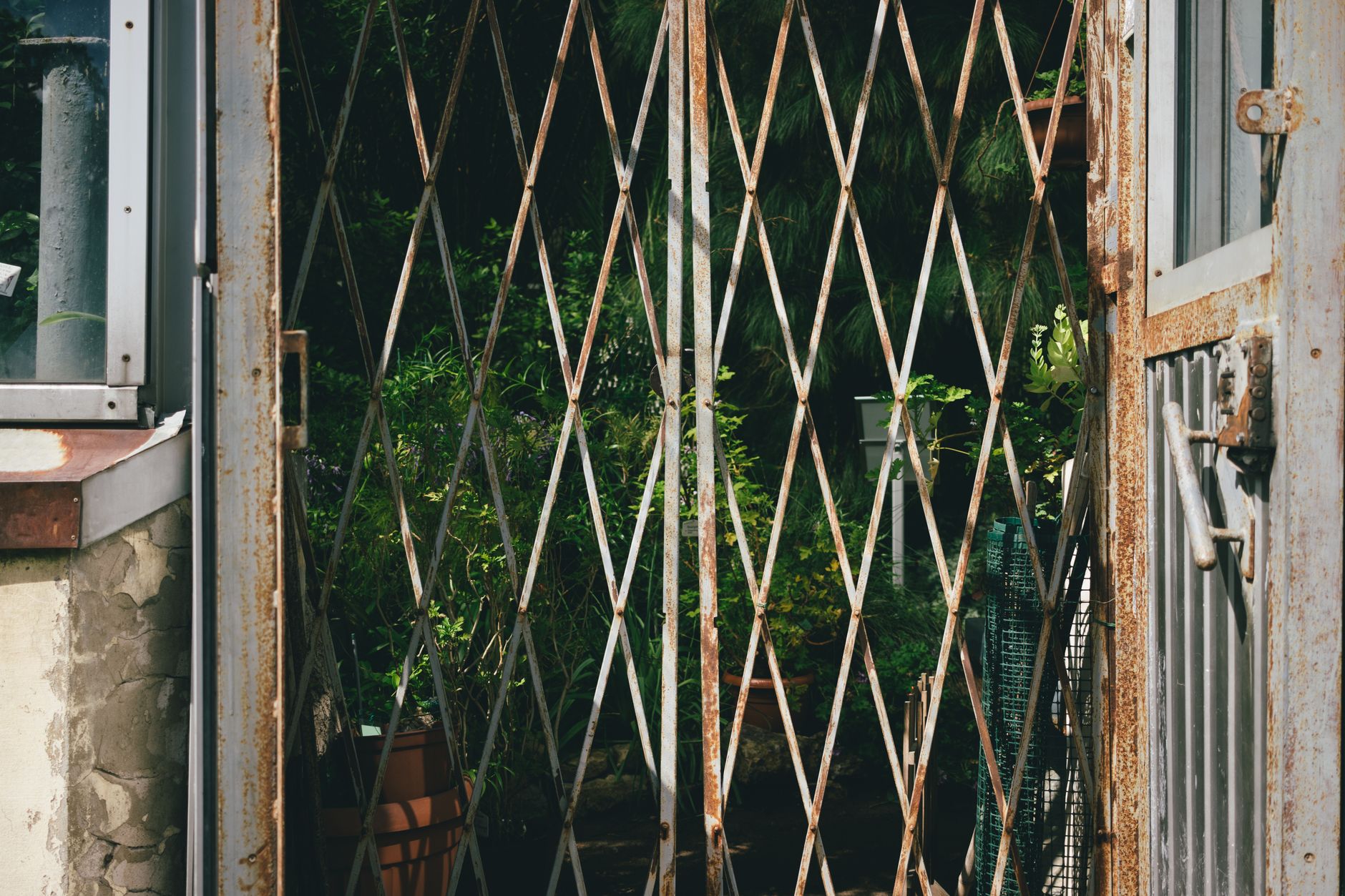
The damage usually shows at the fastener rather than across a whole panel, which is what makes it easy to miss. Look for white powdery buildup around a bolt head on aluminum, a halo of staining spreading out from a washer, or a bolt that will not break loose with normal effort. A bolt that has effectively welded itself into a bracket has already been doing galvanic work for a while.
Isolation is cheap while the gate is being built and expensive afterwards. Nylon or fiber washers and sleeves between dissimilar metals, a barrier coating on mating surfaces, and a dielectric compound on threads all break the electrical path. Ask whether that was done. On an existing gate, the time to add it is the next time a bracket comes off.
Keep the bottom rail out of standing water
Salt water that stands against steel is far more aggressive than salt air alone. Where a drive floods during a spring tide, the bottom rail and the lower hinge sit in brine until it drains. Clearance under the leaf, a drive that sheds water sideways rather than ponding at the gate line, and bottom rails that are capped and drained rather than open to fill all buy years.
Fastener metal is a specification, not a detail
Ordinary zinc plated hardware is not a coastal fastener. It will look fine through the first year and then streak rust down the gate.
Stainless is the usual answer, but stainless is a family, not a material. The common 304 grade performs well in many settings and still develops surface tea staining near the ocean, and in crevices with trapped chloride it can pit. The molybdenum bearing 316 grade is more resistant to chloride pitting and is the sensible default within sight of salt water. Silicon bronze is another durable choice.
Tea staining deserves a word. Those brown streaks on stainless are usually a cosmetic surface film rather than structural loss, and they come off with a non abrasive stainless cleaner and a rinse. Pitting is different: it is localized, it has depth, and it hides under a crevice washer or inside a threaded hole where you cannot see it. If a bolt head looks sound but the shank is reduced when you back it out, the rest of that hardware set is on the same clock.
The low voltage side fails before the steel does
An operator is an outdoor computer with a motor attached. The circuit boards, terminal strips, limit switches and photo eye contacts are the most chloride sensitive parts of the whole installation, and they are the ones a visual inspection of the gate never reaches.
Splices and conduit below grade
Buried splices in a wet, salty water table are a recurring source of intermittent faults. A gate that works in the morning and stalls in the afternoon, or one that loses its safety loop only after heavy rain, is often reporting a connection that fills and drains. Splices belong in a rated above ground junction box, with conduit sealed so it does not act as a straw drawing damp air into the enclosure.
Grounding in sand is not the same job
Sandy soil has high electrical resistivity, especially when dry, so a single short ground rod can measure far worse here than the same rod inland. Surge protection depends on a real low impedance path to earth, and a weak ground turns surge protection into a decoration. If a property has lost control boards in successive seasons, the grounding electrode system is worth measuring rather than assuming.
Let the enclosure breathe downward
Sealed boxes still accumulate moisture, because warm humid air gets in during the day and condenses on cool metal at night. A weep point at the lowest part of the enclosure, gaskets that are intact rather than crushed flat, and cable entries from below instead of from the top all keep that condensate moving out. Open the box each season and look for salt crust on the terminal strip, green on copper, and insects. A thin coat of corrosion inhibitor on connections is a small habit with a long payoff.
Sand, marsh edge and a high water table
Posts here are not fighting the seasonal swelling and shrinking of clay. They are fighting loose sand with low lateral resistance, soft organic soil near the marsh, and groundwater that sits close to the surface.
Loose sand gives a post less grip per foot of depth, so a heavy leaf on a shallow footing leans gradually rather than suddenly. Near the marsh edge, soft organic layers can be deeper than they look from the surface, and a footing that bottoms out in that material will keep settling. The honest version of this conversation includes what the crew found when they dug, not just how much concrete they poured.
The other coastal detail is the ground line itself. A steel post corrodes hardest right where it exits the concrete, because that is where moisture, salt and oxygen all meet. A footing crowned so water sheds away, rather than cupped so it holds a puddle around the steel, is a two minute decision at the pour that decides whether the post rots at grade in year eight.
A rinse routine that outperforms a coating upgrade
Fresh water is the cheapest corrosion control available on the coast. Rinsing a gate every few weeks, and always after a storm pushes spray inland, removes the chloride before the next humid night can use it.
Be deliberate about it. Use moderate pressure, not a pressure washer, since a tight jet drives water past gasket lips and into bearings. Rinse the hardware, the hinge barrels, the latch, the track if there is one, and the outside of the operator housing. Let it dry, then lubricate the moving hardware with a marine grade product that displaces water rather than a general purpose oil that washes off.
Touch up coating damage the week you see it. A chip on the coast is not cosmetic. Bare steel in salt air undercuts the surrounding film quickly, and then the repair stops being a dab of paint and becomes a panel.
Storm season gives the gate a second job
Before a storm, decide what the gate should do and make sure the household knows how to make it do that. Find and practice the manual release while the weather is fine and the lights are on, because learning it by flashlight during an outage is a poor plan. A powered gate with no battery backup is a closed barrier the moment the grid drops, which matters when a crew or a family member needs through.
After water has been over the operator
If salt water has reached the operator, treat the unit as suspect even if it still runs. Brine in a gearbox or a control enclosure keeps corroding long after the surface dries, and a motor that was submerged and then energized can fail days later. Power it down, let a technician open and inspect it, and expect that boards, limit switches and bearings may need replacing rather than drying out. Hinges, rollers and track that sat in salt water want a thorough fresh water flush and relubrication on the same visit.
What a straight answer sounds like
When someone quotes a gate or comes out to fix one, a few questions sort the coastal specialists from the general crews. What stainless grade is the exposed hardware. Are dissimilar metals isolated at the brackets. Where are the splices, and can you show me the junction box. How is the operator grounded, and has anyone measured it. Is the footing crowned at the post. Will the safety photo eyes and edge sensors be tested with me before you leave.
Plain, specific answers are a good sign. A shrug at the grounding question on a property that has already lost one control board is the most useful answer of all, because it tells you where to look next.
A calendar built for this climate
Monthly, test the safety devices by interrupting the beam and pressing the edge, and confirm the gate stops and reverses. Every few weeks through the warm months, rinse the gate and hardware with fresh water. Each season, open the operator enclosure, look for salt crust and insects, check that bolts are tight and that nothing is seized, and lubricate the moving parts. Twice a year, inspect welds, bottom rails, cut ends and the ground line at each post, and touch up every chip you find.
None of that takes long. It simply has to happen more often than it would two hundred miles inland, because the air here is doing corrosive work every single night.